
Growing up, this was an easy question. Who wrote the Bible? GOD, of course! Duh.
As we got older, some of us grew a bit itchy with that simple answer. We know God made the wind, but we also know the science behind what makes tornadoes. The question didn’t get more complicated, but we needed a more robust answer.
“All Scripture is inspired by God and is profitable for teaching, for rebuking, for correcting, for training in righteousness, so that the man of God may be complete, equipped for every good work.”
— 2 Timothy 3:16-17 (CSB)
“All Scripture is inspired by God…” Some versions say “God-breathed.”
So God wrote the Bible. Well, he didn’t LITERALLY write it with his own hand. He inspired it. Breathed it. But what exactly does that mean? Scripture itself mentions human authors, so who were they? How did that work? Honestly, I don’t know. Scholars have discussed and debated this for centuries. I won’t pretend I know more than them.
What I do know: The Bible didn’t just fall out of the sky.
God didn’t write it in the clouds or send an email detailing everything he wanted us to know. And that’s actually a really beautiful thing! Just like he did in the Garden of Eden, just like he does today, God invited humans to work with him. He invited them to participate in his good work.
How they divided that labor varied by author and era. In some cases, God spoke and told them what to write. (See examples in Exodus 17:14, Deuteronomy 31, and Habakkuk 2:2.) Other times, the human authors were “carried along by the Holy Spirit” (2 Peter 1:20-21). Some used their own creativity to express emotion and personal experiences to teach about God and what it means to walk with him (See the Psalms, Song of Songs, and Proverbs for examples.) And some just wrote down what they saw or studied or thought. Some wrote letters to friends, likely unaware then that one day people would read those words as Scripture.
Here are some fast facts.
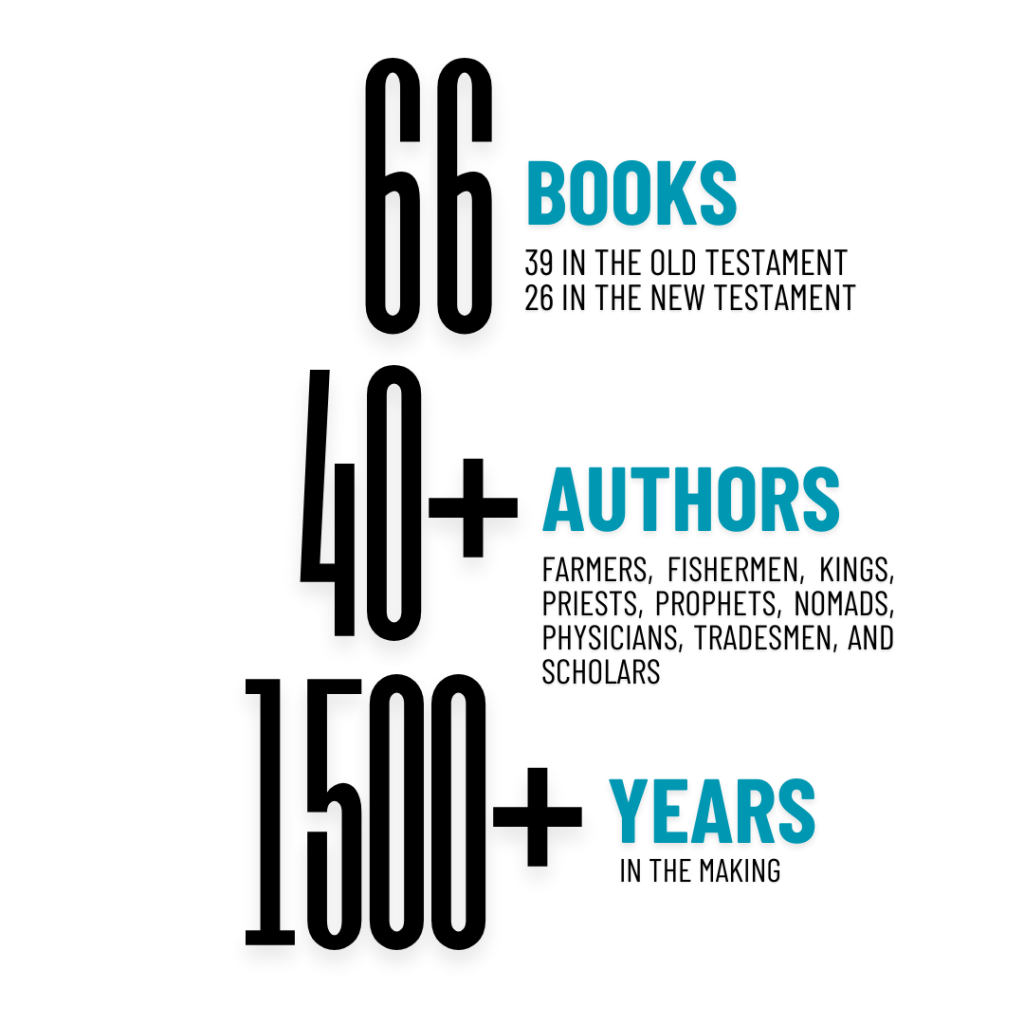
We know that Bible was created through a cooperative effort between the Divine and humans. There’s a lot we could discuss regarding the canon: who decided what made it into the Bible and what didn’t and why some Bibles have “extra” books. We could also spend days talking about original languages and translations. We’re going to save all that for other posts.
Today, we’re just tackling one question.
Who were the human authors of the Bible?
We face a lot of debate when asking this question. There are traditional views and then there are modern scholarly views. The traditional views most often rely on repeated oral traditions or reasonable conclusions based on specific verses, names, or titles. The modern scholarly views go beyond common assumptions and investigate what we can learn from archeology, history, and contextual criticism.
Very few writings in the Bible actually name an author. Some do, and that’s great! For the rest, we can take our best, educated guesses.
With that said, let’s consider some of the big names and what they might have authored. I’ve tried to keep these close to the order in which you’ll find these books in Scripture, but I also group books together if written by the same author (or type of author).
MOSES
- Genesis
- Exodus
- Leviticus
- Numbers
- Deuteronomy
The first 5 books of the Bible are known as the Pentateuch (penta = five) or The Law of Moses. The traditional and conservative view is that Moses wrote all these books minus the accounts of his death at the end of Deuteronomy. Those could have been added in by a scribe later.
There are a number of Old Testament verses that say Moses wrote things down. There are also some references in the New Testament that link Moses to the Torah and written books of the Law. We know that scrolls of the Law existed before the Exile (2 Kings 22). We just don’t know for sure that Moses wrote all five books.
Most scholars today believe the stories and accounts were handed down through oral traditional and repetition, then composed and compiled beginning 800 years after Moses’s death by a team of scribes post-Babylonian exile. This would have been between the 6th and 10th centuries BCE, and it makes a lot of sense. The people of Israel were suffering an identity crisis. Consolidating their stories, history, and laws in one agreed-upon writing would have been a vital step toward solidifying their collective place in the world.
This job of compiling, consolidating, and editing the accounts was likely done by teams of scribes working together over several centuries. The writings fall into four buckets based on stylistic choices, vocabulary, structure, and thematic emphasis. These have been identified as J (Jahwist), E (Elohist), D (Deuteronomist), and P (Priestly).
JOSHUA
- Deuteronomy
- Joshua
If you believe Moses was the author of the Pentateuch, then he had to have someone add in the bits about his death. Joshua is the obvious choice for that job. He followed Moses in leading the people of Israel.
It is also widely accepted that Joshua authored the book carrying his name.
SAMUEL
- Judges
- Ruth
- 1 Samuel
Some believe Judges was written by several different authors, like an anthology of sorts. That’s possible, but most believe it was written by Samuel.
No author is listed for Ruth, but because her story is so closely tied to Judges and it directly leads into Samuel (with the lineage of King David), many attribute it to Samuel. It’s possible, but no one really knows.
As for 1 and 2 Samuel — these were once written as a single book. It was too long to fit all on one scroll, so they used two. Thus, first and second. The traditional view says Samuel wrote this, but we again face the difficulty of recording one’s own death. So either Sam only wrote the first 24 chapters or these books were written by other hands.
PRIESTS & SCRIBES
- 1 & 2 Samuel
- 1 & 2 Kings
- 1 & 2 Chronicles
None of these books list authors. They don’t even hint at them. Some believe that the prophet Nathan (the one who confronted David about his sins) wrote the books of Samuel. That makes sense. It could be that he and Samuel shared the work of the first book, and an unnamed priest helped with the second.
1 & 2 Kings and 1 & 2 Chronicles were most likely recorded by priests or scribes who worked for the monarchies. The texts even mention “the annals of the king.” A lot of writings have been lost, but it seems reasonable and plausible to believe that these writings recording the nations’ big events were penned by those working for those in charge at the time.
EZRA & NEHEMIAH
- Ezra
- Nehemiah
This is an interesting one. Ezra and Nehemiah were contemporaries. Almost everyone agrees that Ezra wrote Ezra. Nehemiah contains first-person narratives, but many believe it was actually compiled and edited by Ezra. Ezra was known as “The Chronicler” and, as such, has also been credited with authoring 1 & 2 Chronicles. I like the idea of friends championing one another’s testimonies.
DAVID, SOLOMON, & OTHER POETS
- Psalms
- Proverbs
- Ecclesiastes
- Song of Songs
Most of the Psalms say who wrote them, and most of them were written by David. Solomon is credited with Proverbs, Ecclesiastes, and Song of Songs (sometimes called Song of Solomon). Along with these two, we have a chorus of poets who wrote songs, couplets, and words of wisdom and devotion.
PROPHETS
- Isaiah
- Jeremiah
- Lamentations
- Ezekiel
- Daniel
- Micah
- Nahum
- Hosea
- Amos
- Obadiah
- Zephaniah
- Habbakkuk
- Zechariah
- Haggai
- Malachi
All of these books state at the beginning that they were the prophecies or the visions of messages from God given to these specific people. While it is safe to conclude that the prophets wrote these books themselves, it is also possible that they had apprentices or assistance who helped them in their ministries.
Note that Jeremiah wrote the book named after him as well as the book of Lamentations.
It is interesting (to me) that only Ezekiel uses first person (‘I’ instead of ‘he’). You’ll notice a few asides and parenthetical clarifications in third person. These were likely added by a scribe editing or copying the scrolls at a later date.
MATTHEW AND MARK
- The Gospel According to Matthew
- The Gospel According to Mark
Neither of these books explicitly name an author, but everyone seems to agree that Matthew (a former tax collector, one of the twelve) wrote Matthew and Mark wrote Mark.
Who was Mark? He actually went by John Mark. He was a companion of both Simon Peter and the Apostle Paul. Many believe that Mark’s writings were heavily fueled by the memories of Peter, who walked with Jesus as one of the twelve.
LUKE
Luke was a doctor and a scholar. He was also a traveling companion of the Apostle Paul. He’s mentioned several times in Paul’s letters. This studious and curious person wrote both the gospel that shares his name and stories of the early church.
- The Gospel According to Luke
- Acts of the Apostles
JOHN
- The Gospel According to John
- 1, 2, & 3 John
- Revelation
The Apostle John, son of Zebedee, one of the twelve, very likely could have written all five of these books. That is a common position. There is, however, a bit of debate.
Dionysius, a bishop of Alexandria during the 3rd century, argued that there were two authors for these books. He noticed distinctions in literary style and vocabulary. These led him to argue that Revelation was written by a different John. A number of scholars have agreed with him over the centuries.
I’m no expert in Greek, but those who are say the Gospel account and the three letters are sophisticated and philosophical in tone and style. Meanwhile Revelation uses more informal, less polished language. Is this just a reflection of the literary genre? Or does it indicate a different John as the author? I don’t actually know.
PAUL & his TEAM (including TIMOTHY)
While many books in the Bible are named after those who wrote them, Paul’s letters in the New Testament were named after those who received them.
Following the proper structure of a letter of that time, every one of these books starts by saying who it’s from and who it is to. You can literally find these details in the first couple verses of each one.
- Romans
- 1 & 2 Corinthians
- 1 & 2 Timothy
- 1 & 2 Thessalonians
- Galatians
- Ephesian
- Philippians
- Colossians
- Titus
- Philemon
We call these the Pauline Epistles — the letters of Paul — but he’s not the only author. He had a number of coworkers in the ministry who traveled with him, took care of him, and helped him with many things, including writing letters. We know this because the letters say it.
At the end of Romans (16:22) someone named Tertius admits to writing the letter for Paul. 2 Corinthians, Philippians, Colossians, and Philemon all say they are from Paul and Timothy. 1 & 2 Thessalonians cite Paul, Silvanus, and Timothy as the authors. Galatians says it’s from Paul and “all the brothers with me.”
PETER, JAMES, AND JUDE
- 1 & 2 Peter
- James
- Jude
There isn’t much argument about these three. 1 & 2 Peter were written by Simon Peter (one of the twelve). James and Jude were both brothers of Jesus. They wrote the books that bear their names.
UNKNOWN
We may have encountered a lot of debate and controversy over other books of the Bible. These? We really have no idea.
- Job
- Esther
- Jonah
- Hebrews
Some popular theories… People like to lump Job in with Genesis and therefore give authorship to Moses. Maybe. I tend to lean toward simple oral tradition that was molded and shaped over generations of storytellers. There is no one author, just one really cool God with a great story.
Esther must have been written by someone high up in Persian aristocracy. Some claim Mordecai (Esther’s uncle) wrote it. He would be a good guess since very few other than he and Esther could have known all the details held within that book.
While some say Jonah wrote his own book, I don’t buy it. First, if you believe the book to be a parable or fable, then Jonah was a fictional character. Second, if you believe it is a true and literal story, no actual person would publish a true story that makes himself the villain. Jonah has no redemption in this story! It ends with him pouting and bitter. Not a good look. I don’t know who wrote it, but I don’t think it was Jonah.
So what? What now?
Some people may think that acknowledging the human side of writing Scripture diminishes the wonder. I would argue the opposite. It doesn’t remove mystery; it shifts it. It gives it flesh. And, for me, it increases hope and joy in knowing how God might use us.
If he inspired all of these people of various backgrounds, vocations, and pedigrees to write words that would inspire generations, what might he want to inspire in us? How might he desire for us to change the world and impact culture and make his name known to the nations?
Keep asking questions.
Now, that’s the philosophical answer to “So what?” and “What now?” A more practical answer is that now we can keep digging. We can keep asking good questions. Like…
- Where did this author live?
- What was his life like?
- Did he have a family? What might they have thought of his writings?
- Why did this author write it this way?
- How might the culture of his time influenced him or his understanding of God?
- Why was this message so important to the people of that day?
- What challenges might he have faced after sharing this message?
Asking questions like this can help us understand Scripture better. Remember: The Bible was written for us, but it wasn’t written to us. We must first seek to understand as the original audience would have understood. Then we can draw out timeless truths about God for us today.
Read more.
If you’d like to learn more about the Bible and how it came to be, I highly recommend Michael Bird’s book 7 Things I Wish Christians Knew About the Bible. (Follow this link for my review.) It talks about how we got the Bible, what ‘inspiration’ means, how we know the Bible is true, why history is so important when reading the Bible, and much more. Like I said, HIGHLY RECOMMENDED.
Your turn.
This may be one of my longest blog posts, but good news: I’m done. Now it’s your turn. What are your thoughts on all this? Any questions? I want to hear them. Any books to recommend? Leave some words for me in the comments.
 Tanya Dennis Books
And so many interpretations of those very words breathed by God. Such a conundrum. Right, wrong ??? Which theology? Literal, contextual, cultural, imperfect men. SalSent from my iPad
LikeLike
We have no choice but to consistently return to the greatest commandments: Love God and love others. Pursue justice, love mercy, walk humbly.
LikeLike
As always Tanya you always give me food for thought with all your writings. This time I was left stunned. According to my NIV study bible, John the apostle & son of Zebedee, wrote Revelations while in exile on the island of Patmos. Now you write that it is “general consensus” that a different John wrote this book. Mind blown!!
LikeLike
Hey, Pam! I saw your email before I saw your comment here. I’ve updated my post to remove the assertion of a “consensus.”There is debate about the authorship of Revelation, a debate that goes back hundreds of years! But there’s not really a consensus, and I want to be fair in my representation of the conversation. It’s so fascinating, though, isn’t it?
LikeLike